
Start here · Fundamentals
How a solar and battery system actually works
The questions everyone asks first, answered in plain English. No experience needed.
- kW is power, kWh is energy. Power is how fast. Energy is how much. Think of a tap: kW is the flow, kWh is the bucket. Your bill charges kWh; equipment is rated in kW.
- Sizing rule of thumb: 1 kW of panels makes roughly 4.5 kWh a day on a good Sydney roof. So a house using 20 kWh a day needs about 4.4 kW to match the year, not 20 kW.
- The inverter sets the ceiling. Panels are rated in DC watts in a laboratory. The inverter’s AC rating is the most the house and the grid ever see.
- More panels than inverter is normal. An array almost never reaches its nameplate, so it is oversized on purpose, up to 133% for systems claiming STCs. That wins energy in every hour that is not noon and costs a small clipped sliver at midday.
- A battery is quoted twice: kWh for how long it runs, kW for what it runs at once.
- Backup is not automatic. A battery only carries a house through a blackout if a backup gateway and an essential-circuits sub-board were wired in at installation.
Four numbers cause most of the confusion on a solar quote: the watts on a panel, the kilowatts on an inverter, and the two numbers on a battery. Get those straight and the rest follows.
Start anywhere. Every section below answers one question, and none of them assume you have bought a system before.
1kW and kWh: what is the difference?
kW is how fast energy is flowing right now. kWh is how much you used over time.
This is the idea everything else rests on. It is easiest to picture as water.
Same sum as the tap: 10 litres a minute for 6 minutes is 60 litres.
- Your bill charges kWh. Like a water bill, it counts how much you used.
- Equipment is rated in kW. Like a tap, it is rated by how fast it can go.
Around the house
| Appliance | Power: how fast | Running for | Energy: how much |
|---|---|---|---|
| Kettle | 2.2 kW | 3 minutes | About 0.1 kWh |
| Fridge | A few hundred watts at most | All day, on and off | About 1 kWh a day |
| Ducted air conditioning | About 4.5 kW | 4 hours on a hot evening | About 18 kWh |
| EV charger | 7 kW | 4 hours | 28 kWh, about 160 km of driving |
The kettle draws far more power than the fridge. The fridge still uses more energy across a day, because it never stops.
Two things worth holding onto:
- A big kW rating is not a lot of energy. A large array on a shaded east-facing roof can produce less than a smaller one facing north.
- A big kWh battery may not run your house. That depends on its kW rating, which is a separate number. See the battery section.
2Which numbers describe a system?
Four ratings, plus one limit set by your network. A quote that gives you only one of them has not told you what you are buying.
People mix these up all the time. Each is measured at a different point, in a different unit, and limited by something different.
| Rating | Unit | Where it applies | What limits it |
|---|---|---|---|
| Array size | kW DC | On the roof, before conversion | Roof area, budget, the 133% oversizing rule |
| Inverter size | kW AC | At the switchboard | Model chosen, network approval, phases available |
| Battery energy | kWh | Storage, over time | Cells purchased, usable depth of discharge |
| Battery power | kW | Instantaneous discharge | Battery and inverter hardware, not capacity |
| Export limit | kW | At the connection point | Your distribution network’s approval |
3What do a panel’s watts mean?
They are a laboratory figure. On a real roof, about three-quarters of it at the best moment of a clear day is a healthy system.
A panel labelled 475 W makes 475 W under Standard Test Conditions:
- 1000 W/m² of light
- a cell temperature of 25 °C
- a defined light spectrum
Those conditions exist in a laboratory. They do not exist on a roof in Sydney.
The fuel figure on a new car’s windscreen sticker is measured in a laboratory, so every car can be compared fairly. Nobody gets it on a real road. A panel’s watts work the same way.
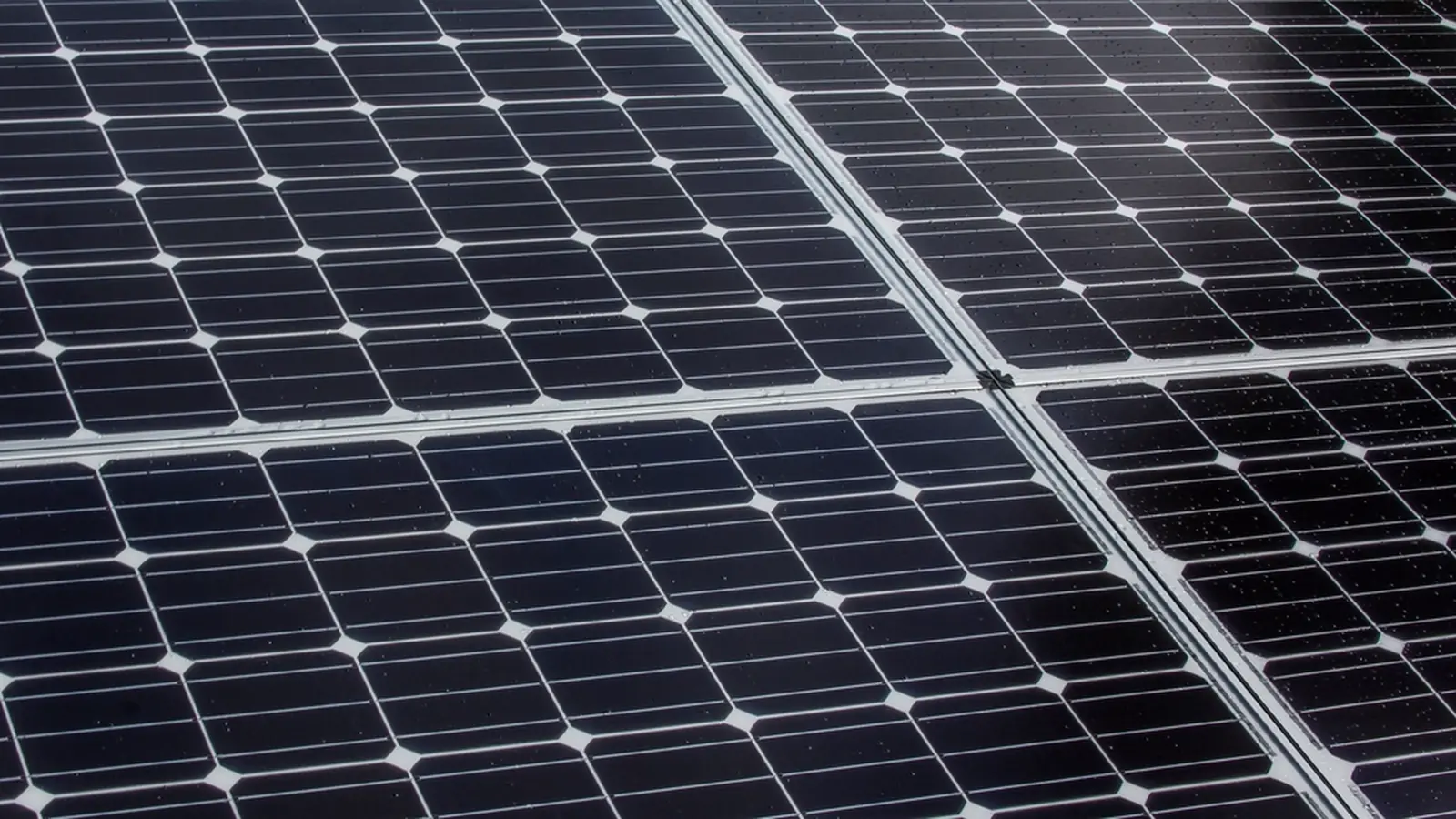
Array size is the panels added up
That figure is what small-scale technology certificates are calculated on. It is also the number most people quote when they say “I have a 13 kW system”.
What reaches your switchboard is less
And every reason is normal.
“My solar is underperforming” is the most common call we get. The answer is usually arithmetic, not a fault.
More detail: where the difference goes
| Loss | Typical scale | Can design fix it? |
|---|---|---|
| Cell temperature above 25 °C | Roughly 0.3% per °C, so 9–12% on a hot roof | Partly — airflow under the array, string design for temperature |
| Orientation and tilt | 0–20% depending on the roof plane | Partly — panel placement, splitting across planes |
| Shading | Anything from trivial to severe | Yes — string layout, optimisers or microinverters |
| Soiling and dust | 2–5% between rain events | Cleaning, and tilt that lets rain do the work |
| DC cabling and mismatch | 2–4% | Yes — cable sizing and matched strings |
| Inverter conversion | 2–3% | Marginally — equipment choice |
Across a year, budget 4.5 kWh per installed kW per day on a well-oriented, unshaded roof. Drop that to around 3.5 where orientation or shading works against you.
A clear summer day runs well above that. An overcast winter day runs well below. This is the number that turns a bill into a system size: see how big a system do I need.
4What do an inverter’s watts mean?
The most AC power it will ever deliver. Whatever the roof can do, this is the ceiling.
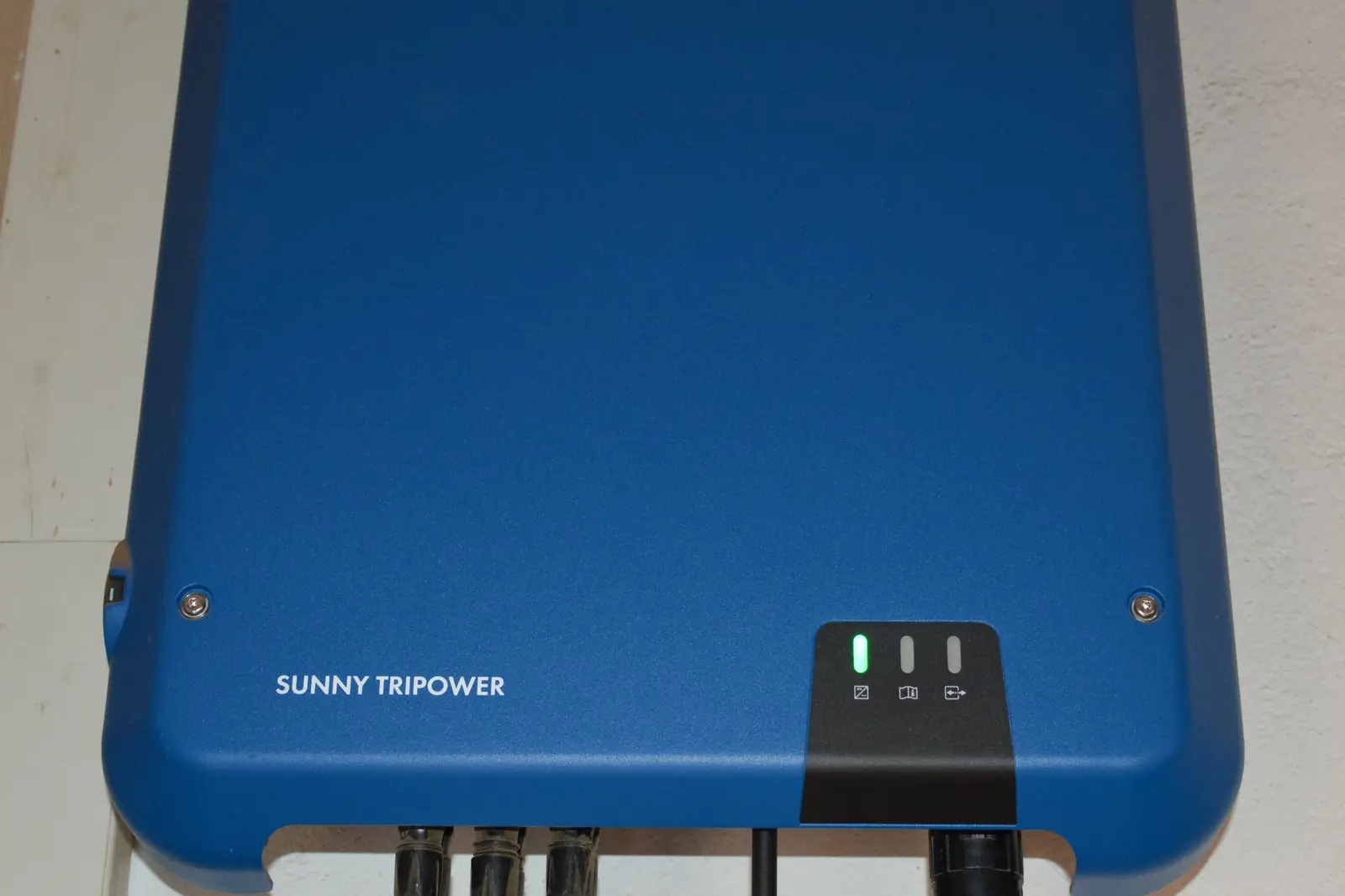
The inverter turns DC from the roof into AC your house and the grid can use. Its rating, say 5 kW or 10 kW, is its maximum output.
Back to the water: the panels fill the pipe, and the inverter is the tap at the end of it. However much is pushing behind it, nothing comes out faster than the tap allows.
Three things about that number matter in practice:
- It is the number the network cares about. Connection approvals and export limits are written against inverter capacity, not panel count.
- It is continuous, not peak. An inverter is built to sit at its rating all day in summer. Some derate slightly in high heat, which is a reason not to mount one in full afternoon sun.
- It has its own DC input limits. Maximum DC input power, maximum current per MPPT and maximum input voltage are all on the datasheet. String design has to respect every one.
More detail: MPPTs and cold mornings
An MPPT, or maximum power point tracker, is the circuit that keeps hunting for the voltage at which a string makes the most power. Most home inverters have two.
Each roof plane with a different orientation generally wants its own. So the number of MPPTs, not just the kW rating, decides whether an inverter suits a roof.
Array voltage peaks on the coldest clear morning, not the hottest afternoon. A string sized only for summer can exceed the inverter’s window in July.
5How big a system do I need?
Divide your daily kWh by 4.5. A house using 20 kWh a day needs about 4.4 kW of panels to match the year, not 20 kW.
This question usually arrives with the mistake already in it: “my bill says I use 20 kilowatt-hours a day, so I need 20 kilowatts of solar.”
Those are different units. 20 kWh a day is energy over time. 20 kW is power at an instant.
It is like saying you drive 400 km a week, so you need a car that does 400 km/h.
System size in kW × 4.5 ≈ kilowatt-hours generated per day, as an annual average on a well-oriented, unshaded Sydney roof.
Run it backwards to size a system: daily kWh ÷ 4.5 ≈ the kW that matches your consumption over a year.
Twenty kilowatts of panels on that roof would make around 90 kWh a day. That is four and a half times what the house uses.
Adjust 4.5 for your roof
| Situation | kWh per kW per day | A 6.6 kW array makes |
|---|---|---|
| North-facing, good tilt, no shade | 4.5 | 30 kWh |
| Split east–west, or a flatter pitch | 4.0 | 26 kWh |
| Some shading, or a poor orientation | 3.5 | 23 kWh |
| Clear midsummer day | 5.5–6 | 36–40 kWh |
| Clear midwinter day | 2.5–3 | 17–20 kWh |
| Overcast winter day | under 1 | under 7 kWh |
Look at the last three rows. 4.5 is an average. A system sized to match your usage on average makes a surplus every summer day and falls short every winter day.
That is one reason the answer is rarely the number the division gives you.
Will it fit on the roof?
A 475 W panel is a little over 2 m², so each kilowatt is about 4.5 m² of panel. Allow 5 to 6 m² of roof per kW once you count setbacks from edges and ridges, access paths and the odd vent or aerial.
A 10 kW system wants around 50 to 60 m² of usable roof. One or two planes is better than five.
The real question: where does the energy go?
That last line is what the sizing conversation is really about. The house cannot absorb what it is not awake for.
Every kilowatt-hour above the middle bar leaves at the feed-in rate, which is a fraction of what you pay to import. So past a certain point, extra panels stop cutting your bill and start selling cheap electricity to your retailer.
6So why not just double it?
We often recommend more than the division gives, for five good reasons. Export limits, roof space and diminishing returns then cap it.
20 kWh a day implies roughly 4.4 kW. Yet we frequently recommend 6.6 kW or 10 kW to that same household. That is not a contradiction.
Five reasons to go bigger
- Winter. A system that matches the annual average makes roughly half of that in midwinter, when a heated house is using more.
- A battery, now or later. Storage only earns its keep if there is surplus to store. In the third bar of the diagram in the previous section, the same array covers 18 of the 20 kWh once a battery moves the daytime surplus into the evening. The surplus has to exist first.
- An EV. A car adds roughly 10–15 kWh on a driving day, and you can schedule it for the middle of the day. It is the single biggest legitimate reason to add panels.
- Electrification. Replacing gas hot water, cooking or heating moves energy onto the electricity bill, usually onto loads you can time for daylight.
- Cost per kW falls as size rises. Much of the cost of a job is the same at 6.6 kW as at 10 kW, so the extra panels are close to the cheapest energy you will ever buy. It is also why installing once beats installing twice.
What caps it anyway
| Limit | How it bites |
|---|---|
| Export limit | Single-phase homes are commonly capped around 5 kW of export. Past that the surplus has nowhere to go unless you store or use it. |
| Inverter and phases | A large array needs a large inverter, and large single-phase inverters are often not approvable. Three phase changes the answer. |
| Usable roof | 5–6 m² per kW, on planes that are not shaded and not facing the wrong way. |
| Switchboard and mains | Space for the protective devices, condition of the board, and whether the mains can carry the added load. |
| Diminishing returns | Each extra kW is worth less than the last once self-consumption is saturated, because the marginal kilowatt-hour is exported rather than used. |
If a household is out all day, has no battery, no EV, no plan to electrify and a tight export limit, the right answer is a modest system, and we will say so.
Shading, roof condition or a switchboard that needs work first can also make the right answer “fix that, then size this”.
More detail: can panels be added later?
Sometimes. It is worth asking before the first system is designed, not after. Three things decide it:
- Whether the inverter has DC headroom left inside the 133% rule and its own input limits.
- Whether the new panels can form a sensible string with the existing ones: matched orientation, matched module characteristics.
- Whether the network will vary the existing approval.
Certificates are created on the added capacity at the rate applying when it is installed, not the original rate.
In practice, a system designed with the next stage in mind — inverter headroom, spare switchboard space, cable capacity — costs very little extra now and a great deal less later.
More detail: what sizing will not do
No array size takes a bill to zero.
- There is a daily supply charge regardless of what you generate.
- Unless you have storage, everything consumed after dark is imported at the full rate.
Sizing decides how much of your daytime load you cover and how much surplus you have to work with. Storage, load shifting and tariff choice decide most of what happens to the rest.
7Why is a 10 kW inverter given 13 kW of panels?
Because the panels almost never reach their rating. The extra panels fill in the morning, the afternoon and winter.
It sounds like someone is cutting a corner. It is the opposite: it is the design working properly.
- A 13.3 kW array reaches 13.3 kW essentially never.
- On a good Sydney day it peaks around 9–10 kW for a short window either side of noon.
- It spends the rest of the day well below that.
Match a 13.3 kW inverter to it and you have paid for inverter capacity that sits idle from dawn to dusk, every day, for twenty years. Oversizing the array fills in the shoulders of the day instead.
For a system claiming small-scale technology certificates, the array’s rated output may not exceed 133% of the inverter’s rated AC output.
A 10 kW inverter can therefore carry up to 13.3 kW of panels. 28 panels of 475 W is exactly 13.3 kW: right at the cap, and allowed.
Two more limits are checked at design:
- The manufacturer’s maximum DC input for that specific inverter, which can be more or less generous than 133%.
- The network’s approval, which is granted against inverter capacity and export limit. Adding panels under an approved inverter does not change what you may export.
More detail: choosing a DC-to-AC ratio
| Ratio | When it suits | Trade-off |
|---|---|---|
| 1.0–1.1 | Unshaded north-facing array at good tilt, or a site that needs maximum instantaneous output | Inverter idle most of the day; more capital in conversion than in generation |
| 1.15–1.33 | The normal residential case in Sydney, especially across split roof planes | A small clipped period around midday on the best days |
| Above 1.33 | Not available on a system claiming certificates | Ineligible for STCs, whatever the hardware allows |
8What is clipping, and what does it cost?
Around noon on the best days, the inverter holds output at its ceiling. The cost is real but small, and nothing is damaged.
Clipping happens in the moments when the array could make more than the inverter can pass. The inverter holds its output at the ceiling and moves the array off its maximum power point, so it makes less.
The extra energy is never generated. It is not dumped as heat, nothing overheats, and nothing wears out faster. The panels simply run at a different point on their curve for a few minutes.
Think of a car with a speed limiter set at 100 km/h. The engine could go faster, but the limiter holds it at 100. Nothing is harmed; the engine just works less hard for that stretch.
The cost is dwarfed by what the extra panels earn the rest of the time. On a typical Sydney roof at a 1.3 ratio, modelled clipping usually lands in the low single digits as a percentage of annual output.
It is modelled per site rather than assumed, because the things that drive it vary:
| More clipping | Less clipping |
|---|---|
| Single north-facing plane at optimum tilt | East–west split arrays with two production peaks |
| Cool, bright, clear days — panels perform best when cold | Hot summer afternoons, when output has already derated |
| Clean panels, new array | Any meaningful shading during the middle of the day |
| Ratios approaching 1.33 | Ratios near 1.1 |
Clipping is the price of getting more energy in the morning, the afternoon and all winter. On almost every roof we design, that trade is worth making — and if it is not, the model will show it.
9Is clipping the same as an export limit?
No. Clipping caps everything the inverter makes. An export limit only caps what you send out to the grid.
These two get mixed up constantly, including by people selling systems.
| Clipping | Export limiting | |
|---|---|---|
| Set by | The inverter’s AC rating | Your distribution network, at approval |
| Applies to | Everything the inverter produces | Only energy sent out to the grid |
| Affects self-consumption? | Yes — it is a hard ceiling on output | No — you can use as much as you make |
| Fix | Bigger inverter, or accept the trade | Store it, shift load into the day, or apply for more |
In water terms: clipping is the size of your main tap. An export limit is a narrower pipe out to the street. The house still takes everything it wants first.
A 10 kW inverter export-limited to 5 kW still runs 10 kW of load inside your own house at midday. Only the surplus heading out to the street is capped.
That is why a battery is the standard answer to a tight export limit. It turns energy you are not allowed to sell into energy you use after dark, at full retail value.
The network side is covered in our export limits guide.
10Single phase or three phase: why does it matter?
It changes your export allowance, your EV charging speed and your backup options. Check it before any other decision.
| Single phase | Three phase | |
|---|---|---|
| Typical inverter and export allowance | Lower — commonly capped around 5 kW export | Substantially higher, network-dependent |
| EV charging | About 7 kW at 32 A | About 22 kW at 32 A |
| Backup during an outage | One inverter backs the whole board | Usually one phase only, unless three-phase backup is specified |
| Large loads | All on one phase | Balanced across three |
On single phase and planning solar, a battery and an EV over the next few years? Have the upgrade conversation once at the start, not three times.
11Why does a battery have two numbers?
kWh is how long it runs. kW is what it can run at once. Capacity alone tells you half of what you need.
Every battery has an energy rating in kWh and a power rating in kW. They answer different questions.
Picture the tank and the tap from the first section. kWh is the size of the tank: how long it lasts. kW is the size of the tap: how much it can run at once.
A common question: a 13.5 kWh battery has enough energy for my evening, so why did it not run the house? Because the evening total and the demand at one instant are different problems.
It is a big tank with an ordinary tap. Plenty of water for the whole evening, but the oven and the kettle together want it faster than the tap can pour.
Nothing failed there. The battery supplied its 5 kW and the grid quietly covered the rest. That is how a grid-connected system is meant to behave.
The same evening in a blackout looks very different, because there is no grid to cover the gap. That is the next section.
More detail: the battery specifications that decide something
| Specification | Unit | What it decides |
|---|---|---|
| Usable capacity | kWh | How long it runs. The only capacity figure worth comparing. |
| Nominal capacity | kWh | What the cells hold, including a slice you never get to use. |
| Continuous power | kW | What it can run at once, indefinitely. |
| Peak/surge power | kW for seconds | Whether motors and compressors will start. |
| Round-trip efficiency | % | What fraction of stored energy comes back — commonly around 90% for a complete AC-to-AC system. |
| Backup reserve | % of usable | How much is held back for outages instead of cycled nightly. |
Two more things that surprise people
- Adding kWh does not always add kW. A second battery module usually adds energy. Whether it raises the power rating depends on the product. Check the datasheet.
- AC-coupled and DC-coupled are different retrofits. An AC-coupled battery has its own inverter and sits alongside your existing solar, which is the usual path when adding storage to a working system. A DC-coupled battery shares the solar inverter. That is generally more efficient, but it means replacing the inverter if it is not already a hybrid.
Sizing a battery from your own interval data is a subject of its own: see the battery sizing method.
12What happens in a blackout?
A normal grid-connected solar system shuts down, even at noon in perfect sunshine. Backup needs three things installed on purpose.
This surprises most people. It is deliberate and required.
- Australian inverter standards require anti-islanding protection.
- On losing grid supply, the inverter must disconnect within two seconds.
- If it did not, your roof could keep a dead section of network live while somebody is working on it. Think of a plumber cutting into a pipe they were told was empty.
The protection is not optional and cannot be defeated.
The three things backup needs
- A battery. Solar alone cannot do it. There is nothing to steady a supply that changes with every passing cloud.
- An inverter with a backup output, able to form its own grid rather than follow one.
- A changeover device and an essential-circuits sub-board, wired at installation, so the property is safely isolated from the network before the inverter re-energises anything.
Some systems switch over in tens of milliseconds and most equipment never notices. Others take a few seconds, which is long enough for computers to restart.
If a seamless changeover matters to you, it is a datasheet question to ask before you buy, not after.
13What can backup really run?
Only the circuits wired for it, and only up to the inverter’s backup rating, commonly around 5 kW on a single-phase home.
Backup is genuinely useful and routinely oversold. Everything below is a normal characteristic of a well-designed system, not a fault. All of it is better known before installation than found out during an outage.
| The expectation | What actually happens |
|---|---|
| “The whole house stays on” | Only circuits wired to the essential-loads board stay on. That selection is made at design. |
| “I can run whatever I like” | You are limited to the inverter’s backup rating, commonly around 5 kW single phase. Ducted air conditioning plus an oven exceeds that on its own. |
| “The solar will recharge it during the outage” | Only if the system supports solar recharging while islanded. Not all do. Without it, the battery drains and stays drained until the grid returns. |
| “It will be full when I need it” | Only if a backup reserve was configured. A battery optimised purely for bill savings can be nearly empty at 11pm, which is when storms tend to take the power out. |
| “Three-phase house, three-phase backup” | Usually one phase is backed up. Three-phase loads — some pumps, some ducted units, some workshop equipment — will not run at all. |
| “The pump/compressor will start fine” | Motors draw several times their running current for a moment at startup. Whether they start is a surge-rating question, not an energy question. |
| “I can charge the EV from the battery” | EV chargers are almost never on backup. A single charging session would empty a home battery. |
Battery backup is not life-support equipment. If someone in the house depends on powered medical equipment, that needs a dedicated, tested arrangement with the treating clinician and the distributor’s life-support registration — not a home battery on its own.
How long does backup last?
Reserve energy divided by backed-up load. It is the same sum as a water tank: litres in the tank divided by litres a minute tells you how long until it runs dry.
- Essential circuits typically average 0.3–0.6 kW.
- So 10 kWh available when the power fails runs them for the better part of a day.
- Longer if the system can recharge from solar. Considerably shorter if someone keeps putting the kettle on.
A system designed to run indefinitely with no grid at all is a different specification again: see hybrid and off-grid systems.
14How do I read a quote?
Check five lines: panel count, inverter rating, battery kWh and kW, the export limit assumed, and what backup covers.
Comparing proposals? These five lines tell you most of what you need to know.
- Panel count × panel watts. Does it equal the array size printed at the top? 28 × 475 W must be 13.3 kW, not “about 13”.
- Inverter model and AC rating. Divide the array by it. Under 1.33 is normal. Over it is not eligible for certificates.
- Battery usable kWh and continuous kW. If only one appears, ask for the other before comparing prices.
- The export limit assumed. A proposal modelled on unlimited export at an address that will be approved for 5 kW is a forecast that will not survive connection.
- Backup: included or not, and which circuits. “Battery included” is not the same as “works in a blackout”. The essential-circuits list should be in writing.
Then check the incentive lines:
- The STC discount should show system size × zone rating × deeming period. See the STC guide.
- Any battery incentive should be itemised separately. See the battery rebate guide.
15Glossary
Plain-English meanings for the terms you will meet on a quote.
- AC / DC
- Panels and batteries produce direct current; your house and the grid run on alternating current. Converting between them is the inverter’s job.
- Anti-islanding
- Protection that disconnects an inverter within two seconds of losing grid supply, so it cannot energise a network someone may be repairing.
- Array
- All the panels together. Rated in kW DC: panel count × panel watts, so 28 × 475 W is 13.3 kW.
- Clipping
- Output held at the inverter’s AC ceiling when the array could have produced more. The excess is never generated.
- C-rate
- How fast a battery charges or discharges relative to its capacity. A 13.5 kWh battery at 5 kW is roughly 0.37C.
- Curtailment
- Output reduced to respect a network limit, not a hardware limit. Distinct from clipping.
- DC:AC ratio
- Array kW DC divided by inverter kW AC. Typically 1.15–1.33 on residential work.
- Depth of discharge
- How much of the cells’ capacity the management system will actually use. What separates nominal from usable capacity.
- DNSP
- Distribution network service provider — Ausgrid, Endeavour Energy or Essential Energy in NSW. Owns the poles and wires and sets your export limit.
- Essential circuits
- The sub-board of loads wired to stay live on backup. Chosen at design.
- Export limit
- The maximum you may send to the grid, set by your DNSP at approval.
- Feed-in tariff
- What your retailer pays for exported energy. A fraction of the import rate, set by the retailer and not guaranteed, which is why a system’s value comes from what you use rather than what you sell.
- Hybrid inverter
- An inverter that handles both solar and a battery, and can usually form its own supply for backup.
- MPPT
- Maximum power point tracker. The circuit that finds the voltage at which a string produces most power. Roof planes with different orientations generally want separate ones.
- Round-trip efficiency
- Energy out divided by energy in for a full charge and discharge cycle.
- Self-consumption
- The share of what you generate that you use on site rather than export. The main driver of financial return.
- STC
- Two meanings, and they collide constantly. Standard Test Conditions is how a panel’s watts are measured. A Small-scale Technology Certificate is the tradable certificate behind the solar “rebate”. Context decides which one is meant.
- String
- A set of panels wired in series into one inverter input.
- Specific yield
- Energy produced per kW installed, usually quoted as kWh per kW per day. Around 4.5 on a good Sydney roof, annual average. The number that converts a bill into a system size.
- Usable capacity
- The energy you can actually draw out of a battery. The only capacity figure worth comparing between quotes.
Each figure on this page is a range or a rule of thumb until someone has looked at your roof, your switchboard and your bill.
Common questions
What is the difference between kW and kWh?
A kilowatt (kW) is a rate — how fast energy is moving at this instant. A kilowatt-hour (kWh) is a quantity — a rate sustained for a period. A 2 kW heater running for three hours consumes 6 kWh.
Panels, inverters and battery output are rated in kW; your bill, your consumption and a battery’s capacity are measured in kWh. Almost every confusing conversation about solar is a kW figure and a kWh figure being compared to each other.
What is the difference between panel watts and inverter watts?
Panel watts are DC and are measured in a laboratory at 25°C and 1000 W/m² of light.
Add them up and you get the array size — 28 panels of 475 W is a 13.3 kW array. Inverter watts are AC and describe the maximum the inverter will ever deliver to your switchboard, whatever the roof is doing.
The array rating is what STCs are calculated on; the inverter rating is what the network approves and what the house actually sees.
Can you put 13 kW of panels on a 10 kW inverter?
Yes, and it is standard practice. An array almost never produces its rated output, so an inverter matched exactly to the array sits idle most of the day.
For systems claiming small-scale technology certificates the array may be oversized to a maximum of 133% of the inverter’s rated AC output, so 13.3 kW on a 10 kW inverter (133%) is right at the limit and allowed.
The inverter manufacturer also sets its own maximum DC input, and the network approves on the inverter rating.
My daily usage is 20 kWh. Why are you recommending 10 kW of solar and not 20 kW?
Because kilowatt-hours and kilowatts are different units. 20 kWh a day is energy; 20 kW is power.
As a rule of thumb a kilowatt of panels generates about 4.5 kWh a day on a well-oriented Sydney roof, averaged over a year, so matching 20 kWh a day takes roughly 20 ÷ 4.5 = 4.4 kW of panels.
Twenty kilowatts would generate around 90 kWh a day — four times what the house uses.
We often still recommend more than the 4.4 kW the division gives, because winter output is roughly half the annual average, because a battery or an EV can absorb far more of the surplus, and because the cost per kW falls as the system grows.
What we do not do is size to a figure that came from confusing the two units.
How much electricity will a 6.6 kW or 10 kW solar system produce per day?
Multiply the system size by about 4.5 for a well-oriented, unshaded Sydney roof: a 6.6 kW system averages around 30 kWh a day across a year and a 10 kW system around 45 kWh.
Use 4.0 for a split east–west roof and 3.5 where there is shading or a poor orientation. That is an annual average, not every day: a clear midsummer day runs well above it and a midwinter day around half of it.
Should I size solar to my total usage or my daytime usage?
Both, in that order. Total usage divided by 4.5 gives the array that matches your consumption over a year.
Your daytime usage tells you how much of that you can use as it is generated — typically only 25–40% of consumption in a household with no battery and no EV.
Everything above that is exported at the feed-in rate, which is a fraction of the import rate, so past a point extra panels stop reducing your bill and start selling cheap energy to your retailer.
Storage, shifting loads into daylight or charging an EV are what raise that ceiling.
How much roof space does a 10 kW solar system need?
A 475 W panel is a little over 2 m², so each kilowatt is about 4.5 m² of panel — call it 5 to 6 m² of roof per kW once edge setbacks, access paths, vents and aerials are allowed for.
A 10 kW system therefore needs roughly 50 to 60 m² of usable roof, and works out considerably better on one or two planes than spread across five.
Can I add more panels to my system later?
Sometimes, and it is far cheaper to plan for than to retrofit.
It depends on whether the inverter has DC headroom left inside the 133% limit and its own input ratings, whether the new panels can form a sensible string with the existing ones, and whether your network will vary the existing approval.
Certificates are created on the added capacity at the rate applying when it is installed.
If an expansion is even possible for you, say so before the first system is designed — inverter headroom and spare switchboard space cost very little to leave in place.
Will solar take my electricity bill to zero?
No array size does that on its own. There is a daily supply charge whatever you generate, and without storage everything consumed after dark is imported at the full rate.
Sizing decides how much of your daytime load you cover and how much surplus you have to work with; storage, shifting loads into daylight and your tariff decide most of the rest.
A quote promising a zero bill has stopped describing the physics.
What is inverter clipping and how much does it cost?
Clipping is what happens when the array could produce more than the inverter can pass.
The inverter holds its output at the ceiling by moving the array off its maximum power point — the extra is never generated rather than wasted as heat, so nothing is damaged or overheated.
On a typical Sydney roof at a 1.3 ratio, modelled clipping is usually a low single-digit percentage of annual output, and far smaller than the energy the extra panels add in the morning, the afternoon and through winter.
It is modelled per site, because orientation and tilt change it.
Why does my 6.6 kW system never produce 6.6 kW?
Because 6.6 kW is a laboratory rating at a 25°C cell temperature and full reference sunlight.
On a real roof the cells run 30–40°C hotter than that, the array is rarely at the perfect angle to the sun, there is dust and there are cable and conversion losses.
Seeing roughly three-quarters of nameplate at the best moment of a clear day is normal and is what the design assumed.
What does usable battery capacity mean?
Usable capacity is the energy you can actually take out.
Nominal (or total) capacity includes a slice the battery management system keeps in reserve to protect the cells, which you never see. A battery advertised at 14.3 kWh nominal might be 13.5 kWh usable.
Usable is the only capacity figure worth comparing between quotes, and it is the figure the federal battery discount is calculated on.
Will my solar work in a blackout?
Not on its own.
Australian inverter standards require a grid-connected inverter to disconnect within two seconds of losing grid supply, so that it cannot energise a network that someone may be repairing.
Riding through an outage needs three things that have to be installed deliberately: a battery, an inverter with a backup output, and a changeover device with an essential-circuits sub-board wired at installation.
Solar panels alone, or a battery without that switchgear, go dark with the street.
What will actually run on battery backup?
Only the circuits wired to the backup sub-board, and only up to the inverter’s backup power rating — commonly around 5 kW on a single-phase home.
That usually covers lights, the fridge, internet, selected power points and often one split system.
It usually does not cover ducted air conditioning, an electric oven, the EV charger or the pool pump, and on a three-phase property only the backed-up phase stays live unless three-phase backup was specified.
Which circuits are essential is a decision made at design, not during the outage.
How long will a battery run my house in a blackout?
Divide the reserve energy by the backed-up load.
Essential circuits typically draw 0.3–0.6 kW on average, so a battery holding 10 kWh at the moment the power fails runs them for the best part of a day.
Two things change that answer: whether your system can recharge from solar while islanded, which not all can, and what state of charge the battery happens to be at when the outage starts — which is what the backup reserve setting is for.
Is clipping the same as export limiting?
No, and the distinction matters. Clipping is the inverter’s own AC ceiling and applies to everything it produces, including what your house is using.
Export limiting is a network condition on how much you may send out to the grid, and it never limits what you consume on site.
A 10 kW inverter export-limited to 5 kW can still run 10 kW of load in your own house at midday.
Sources and further reading
- Clean Energy Council — design and install guidelines for accredited designers, including the array-to-inverter oversizing limit that applies to systems claiming certificates
- AS/NZS 4777.1 and AS/NZS 4777.2 — grid connection of energy systems via inverters: inverter requirements and anti-islanding protection
- AS/NZS 5033 — installation and safety requirements for photovoltaic arrays
- AS/NZS 3000 — Wiring Rules, including switchboards and alternative supply arrangements
- Clean Energy Regulator — Small-scale Renewable Energy Scheme: how system size and eligibility are assessed
- Inverter and battery manufacturer datasheets — the source of truth for maximum DC input, backup output rating, surge rating and usable capacity
Revision 1.3 · 5 October 2026. Revision 1.3 added everyday comparisons (a tap and a bucket, a tank and a tap, household appliances) and moved the worked panel example to 28 × 475 W, 13.3 kW. No rules changed. 1.2 tidied the wording; 1.1 rewrote the guide so it is easier to skim.
Figures current at 11 August 2026. Set Energy technical team. NSW Electrical Contractor Licence 467699C.
Want this checked against your actual site?
Send us your latest bill, a photo of your switchboard and your roof plan. We will tell you what the numbers look like for your property — including where the answer is “not yet”.